Traffic Calming Policy
The Lake Worth Beach Traffic Calming Policy outlines how residents can request traffic calming measures, the criteria for evaluation, and the process used to improve roadway safety and reduce speeding in neighborhoods.
Scope and Purpose
The scope and purpose of this policy is to establish:
The objectives and general application of traffic calming within the City of Lake Worth Beach on City owned roadways.
A predictable annual cycle and orderly process for any request that involves traffic calming funds, regardless of where the request originates, and with clear distinctions between identification of a problem by residents and analysis by Palm Beach County Sheriff’s Office traffic monitoring equipment and/or solutions developed by professional consultants/traffic engineers.
Criteria for the review of traffic calming requests to determine further analysis and validation of significant problems and potential traffic calming measures.
Procedures to formally evaluate requests, including data collection, traffic calming studies, and neighborhood meetings to select a preferred solution.
A more equitable ranking procedure, establishing a clear and convincing case to generate a prioritized list of possible traffic calming projects, which can be employed when there are more traffic calming projects proposed than funds available to construct all projects.
This policy neither lists all traffic calming measures, nor attempts to specify which measure would be implemented in certain road or traffic operation scenarios. Proper data shall be utilized by City staff and/or a traffic consultant in certain instances to develop appropriate roadway solutions.
A. OBJECTIVES & GENERAL APPLICATION OF TRAFFIC CALMING
Traffic calming is intended to reduce the impact of motor vehicles on roadways, residents, and road users. In the City of Lake Worth Beach, this means primarily the reduction of motor vehicle speeds. The reduction of motor vehicle traffic volumes on specific roadways is a sensitive issue because of the risk of diverting traffic onto a neighboring road, especially in a City with a traditional roadway grid system. Conversely, some chronic neighborhood traffic problems concern levels of traffic volume on local roadways that some residents may believe is excessive. Typically, a significant portion of the traffic in these cases is considered "through" traffic, because it neither originates from nor is destined to the broader neighborhood. Traffic calming shall be used to reduce the impact of this unwanted traffic.
Collision mitigation might be accomplished by prohibiting the turn movements of a relatively low number of motor vehicles. In these cases, the benefits outweigh other considerations, unless the risk is simply transferred to a neighboring intersection.
Physical Traffic Calming Measures
There is a considerable range of options for traffic calming from enforcement or traffic signs and pavement markings to construction alternatives including speed humps/tables, traffic circles, raised median islands, and bulb-outs/chokers (roadway narrowing). These construction improvements are referred to as "physical" measures in this policy.
Physical traffic calming measures are categorized in two ways:
Vertical deflection: raising the road by using speed humps or speed tables; and
Horizontal shift: moving vehicles off a certain alignment from one side or another (e.g. traffic circles).
Generally, physical traffic calming measures are the most effective form of traffic calming available. The use of these measures requires careful application, so that large vehicles can still navigate where needed. Installation of any new speed humps, speed tables, or platforms would be based on City authority to introduce these measures.
Historically, some physical traffic calming has been installed at the request of the residents when responding to neighborhood concerns about illegal, threatening, or socially disruptive driving or other behavior. Such issues will continue to be considered and evaluated on a case-by-case basis.
The City of Lake Worth Beach's roadway network includes designations such as through, collector (major and residential), and industrial. The following are designated per Chapter 21, Sec. 21-15 of the City’s Code of Ordinances:
Lake Avenue – Through Street (Major Collector)
Lucerne Avenue – Through Street (Major Collector)
1st Avenue South (East of the Florida East Coast Railroad) – Collector (Residential)
2nd Avenue North – Collector (Residential)
4th Avenue South (West of Dixie Highway) – Collector (Residential)
6th Avenue South – Through Street (Major Collector)
7th Avenue North – Collector (Residential)
10th Avenue North – Through Street (Major Collector)
13th Avenue North – Collector (Residential)
Federal Highway – Through Street (Major Collector)
Boutwell Road – Major Collector
Detroit Street – Major Collector
*All other City roads are classified as either Residential or Industrial.
The application of physical traffic measures on through streets is particularly sensitive. Some forms of horizontal shift physical traffic calming can be applied to major roads, but even greater care must be taken when high speeds and/or high traffic volumes are concerned. This helps to ensure road users are not placed in greater risk than by the traffic operation condition being mitigated.
Application of Traffic Calming Measures
If the problem submitted in a written traffic calming request to the City’s Public Works Department is validated by recent traffic records and subsequent data collection, a traffic calming device may be installed and/or a traffic calming study can be authorized depending on the severity. This traffic calming request should include:
A description of the project location
Contact information of the resident/business owner making the request
The reason for the traffic calming request
Any supporting documentation
If the request involves an intersection or street portion, neighboring streets and intersections must be considered in view of the traffic calming measures proposed and potential impacts on the immediate neighborhood assessed if a "spill-over" effect is anticipated. In recommending solutions, less costly and restrictive methods of calming should be considered first.
B. ANNUAL CYCLE & PROCESS FOR TRAFFIC CALMING REQUESTS
The steps in a traffic calming request/implementation process are as follows:
Resident/Business Owner submits a written request to the City’s Public Works Department defining a problem in their neighborhood.
Based on the requested traffic calming location, staff shall define limits of the traffic calming area. Resident/Business Owner collects signatures of support from the staff defined traffic calming area. This petition should include both the resident/property owner’s name, street address, and contact email or phone number for verification purposes.
Should the petition submitted to the Public Works Department meet the proper percentages (please see Section C below), staff utilizes recent traffic records, Palm Beach County Sheriff’s Office resources, and other acceptable methods to evaluate the written traffic calming request submitted for consideration. Validation of any significant problems will occur at this step.
If the request qualifies, staff shall provide a recommendation and/or a traffic calming study can be authorized should funding allow.
If steps 1-4 have illustrated a need for traffic calming, City staff shall prepare a cost estimate and project priority for review by the City Commission on a biannual basis, who will have final approval or denial of the traffic calming solution.
If funds are available in the current fiscal year, the project shall be constructed contingent upon on approval. If funds are not available, the project shall be included in the following year’s budget.
C. CRITERIA FOR REVIEW OF TRAFFIC CALMING REQUESTS
When written traffic calming requests are submitted to the Public Works Department providing information about observable hazardous conditions and impacts, staff shall review the request along with recent traffic records for the area (collisions, speed, volume) and roadway geometry (lane width, on-street parking, grade, sight distance, driveway locations, etc).
The following criteria are used in the initial staff review of traffic calming requests and validation of significant problems for further analysis and potential implementation:
Any residential street area; and
To mitigate a documented collision pattern (bike, pedestrian, motor vehicle); and/or
Where the 85th percentile speed profile is greater than 5 mph over the speed limit; and
Where there is a documented problem of a significant or inappropriate number of "through" motor vehicles on the street orin the neighborhood.
The 85th percentile is defined as the speed at or below which 85% of the observed free-flowing vehicles are traveling and is the most common method utilized in determining roadway speed limits. If there is a good safety record, the speed profile (85th percentile) is within 5 mph of the speed limit, and the traffic volume is appropriate for the street, the applicant will be advised that no further action will be taken.
If this request was not previously denied, Public Works staff shall define a petition area for signature collection by the residents/business owners. When the petition is returned by the person requesting the traffic calming and qualifying support is established from 66% of households/businesses within the defined petition area (51% being actual property owners), evaluation procedures shall be initiated as soon as possible. Original traffic calming requests and petitions can be mailed or delivered in person to the Lake Worth Beach Public Works
Department located at 1749 3rd Avenue South, Lake Worth Beach, FL 33460.
D. PROCEDURES TO EVALUATE REQUESTS FOR TRAFFIC CALMING
Data collection is conducted by the Palm Beach County Sheriff’s Office and/or a traffic engineering firm related to the type and degree of the problem that was defined in the request. This may include raw speeds, vehicle counts, and field surveys to observe conditions. If the data validates the request as a significant problem, staff will define the traffic calming area and provide recommendations and/or a traffic calming study can be authorized.
A cost estimate can then be drafted and presented to the City Commission with a recommendation to utilize current or future funds. Should there be multiple traffic calming requests, project priority must be established
(please see Section E).
E. RANKING PROCEDURE & PRIORITIZING TRAFFIC CALMING PROJECTS
A ranking procedure is applied when the evaluation is completed for potential traffic calming projects. The following point system shall be used to prioritize projects. These projects may include both new requests as well as unfunded items from the prior year (due to limited funds to construct physical traffic calming measures) that still qualify for consideration as significant problems.
Traffic Speeds (85th percentile) 10 points for each mile per hour the 85th percentile is above the speed limit plus 5 mph. (e.g., if the speed limit is 25 mph and the 85th percentile is 32 miles = 2 X 10 points = 20 points) [Average 85th percentile of two directions]
Safety Rating (Collision History)
10 points for each reportable motor vehicle-to-motor vehicle collision in the past five years which would have been preventable with traffic calming (e.g., if a collision is caused by a drunk driver, it may not be correctable with traffic calming and therefore may not factor into the rating).
25 points for each reported pedestrian or bicyclist injury or fatality in the last five years that is considered preventable with traffic calming.
Crosswalks and Sidewalks
25 points for each uncontrolled intersection or mid-block crosswalk.
25 points if there is no sidewalk on a portion of the street in question.
Traffic Volume 1 point for each 100 vehicles of average daily traffic above the following thresholds:
2-way volume on local streets — above 1,000
1-way volume on local streets — above 500
2-way volume on collector / arterial streets — above 2,500
2-way volume on through streets — above 10,000
Bus Stops 15 points for each bus stop area
Proximity to Designated Community Facilities (schools, recreation centers, senior &/or community centers, senior multi-family housing, medical clinics, parks, libraries, etc.) 25 points for each of these types of institutions within 500 feet of the road section or intersection in question.
Bike Facility 25 points if the proposal is on a road containing bike lanes.
Driveways (Conflict Points) 1 point for each driveway.
Proximity to Traffic Control Devices (signals, stop signs) 10 points if there are no traffic control devices within 400 feet.
Proximity to Existing Physical Traffic Calming Measures (speed humps, circles) 25 points if there are no traffic calming measures within 400 feet in any direction.
Trial of Less-Restrictive, Non-Physical, Corrective Traffic Calming Measures 25 points if other methods have been tested already, and proven to be unsuccessful.
F. THE IMPORTANCE OF TRAFFIC CALMING
The City of Lake Worth Beach is a vibrant community and places extreme value in the opinions and recommendations of its residents and business owners. The aforementioned process detailed in this traffic calming policy provides the foundation for sound roadway analysis to result in the safest environment possible for both vehicular and pedestrian traffic within the City. Please direct any traffic calming policy questions to the Public Works Department.
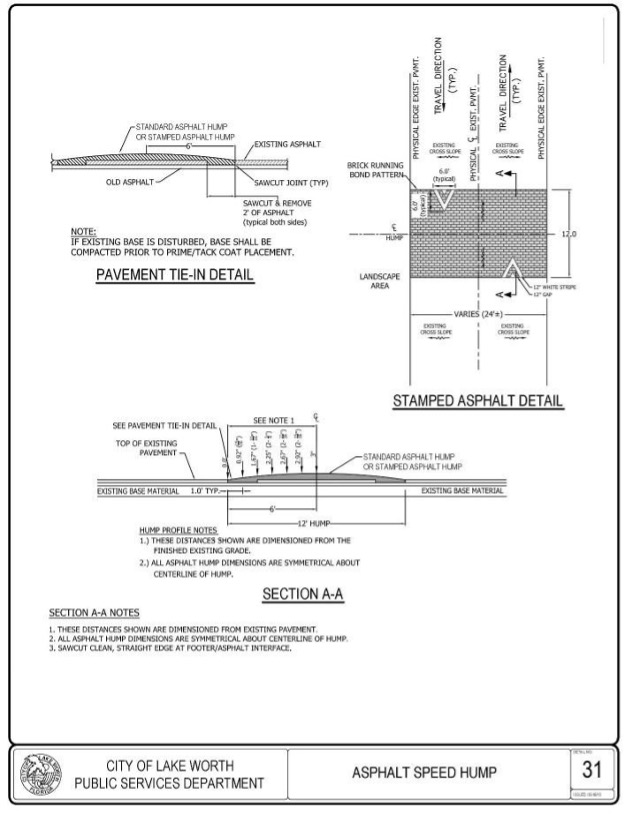
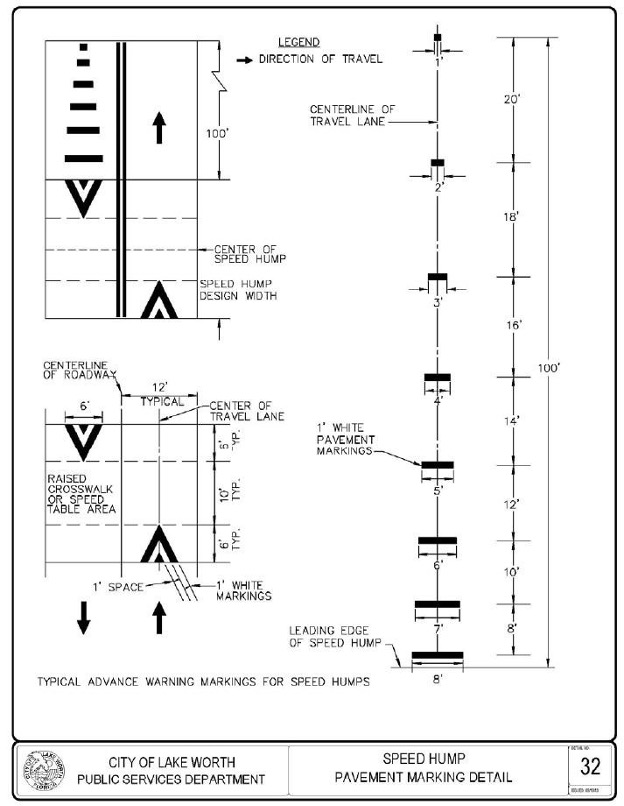
Diagrams:
THE FOLLOWING IS LOCATED UNDER THE CONSTRUCTION STANDARDS AND DEVELOPMENT GUIDELINES IN THE PUBLIC WORKS POLICY AND PROCEDURE MANUAL